

The automobile tire carries lots of useful information about the tire that helps us to know the specification of the tire. This information is stamped in alphanumeric digits (a combination of numbers and letters) known as tire code. Tire code is tough to understand. It works as the keys stamped into the outer sidewall of the tire mostly. Sometimes the inner side of the sidewall also carries information that is not stamped on the outer sidewall. New automobile tires are also provided with a rating for traction, tread wear, and temperature resistance along with load range and load index, speed rating, and DOT code.
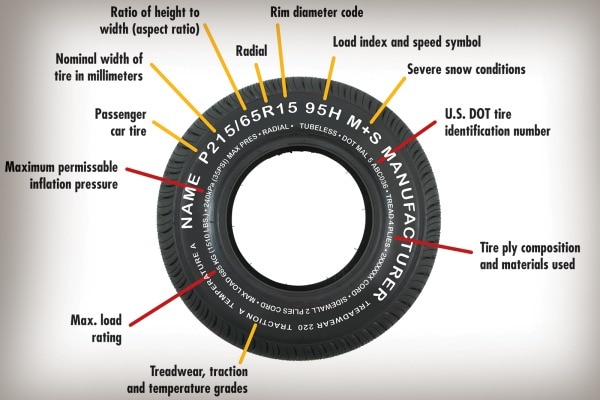
P stands for passenger car, LT stands for light truck, ST stand for special trailer and T stands for temporary which is used for the small spare tires.
The number 215 describes the width of tire from edge to edge of the sidewall. Greater the number larger will be its size.
The number 65 represents the ratio of height to width. So 65 mean sidewall is 65% larger in height than its width.
R refers to radial construction. It is the industry standard for passenger tires.
15 is the rim diameter in inches. If one changes his vehicle tire, it is necessary to consider the diameter of other tires (to get tires of the same diameter or the ones that’ll fit your car).
95 is the load index that indicates the capacity of tire. It is the measurement of how much weight a tire can carry. Larger the number the higher will be load capacity. 95 indicates maximum weight of 1521 pounds.
H represents the speed rating at which the tire is designed to run. H means a tire can run safely at the speed of up to 130mph.
The Department of transportation tire code is an alphanumeric digit that represents the identification and the age of the tire. It is useful for product recall. This number helps the buyers to be notified of the defects.
Uniform Tire Quality Grading (UTQG) rating is present on the bottom of the sidewall that lists:
- Traction: measurement of how tire stops on a wet road. It is represented as AA ( best traction performance), AC (worst).
- Maximum air pressure: measures how much air should be put in before it can be harmed.
- Temperature: the ability of the tire to withstand heat at maximum speed.
- Treadwear rating: measure durability of the tire to a standard reference tire. Higher the number longer the tread and actual tread will last.
Two influential organizations that determine national tire standards are the European tire and Rim technical organization (ETRTO) and Rim and Tire Association (TRA). In the US, the office of vehicle safety is the agency that is tasked for enforcement of Federal motor vehicle safety standards (FMVSS).
No responses yet